Live Smart Routing to the Best Web3 RPC Provider
This document provides an in-depth exploration of live smart routing for Web3 Remote Procedure Call (RPC) providers. It examines the challenges of relying on a single RPC provider, the benefits of smart routing, the mechanisms involved in real-time performance monitoring and dynamic provider selection, and the overall impact on Web3 application performance, reliability, and cost-effectiveness.


David Liu
CTO & Co-Founder
Blockchain
10 Minutes
The Problem: Single RPC Provider Reliance
Web3 applications rely heavily on RPC providers to interact with blockchain networks. These providers act as intermediaries, relaying requests from applications to the blockchain and returning the results. However, relying on a single RPC provider presents several challenges:
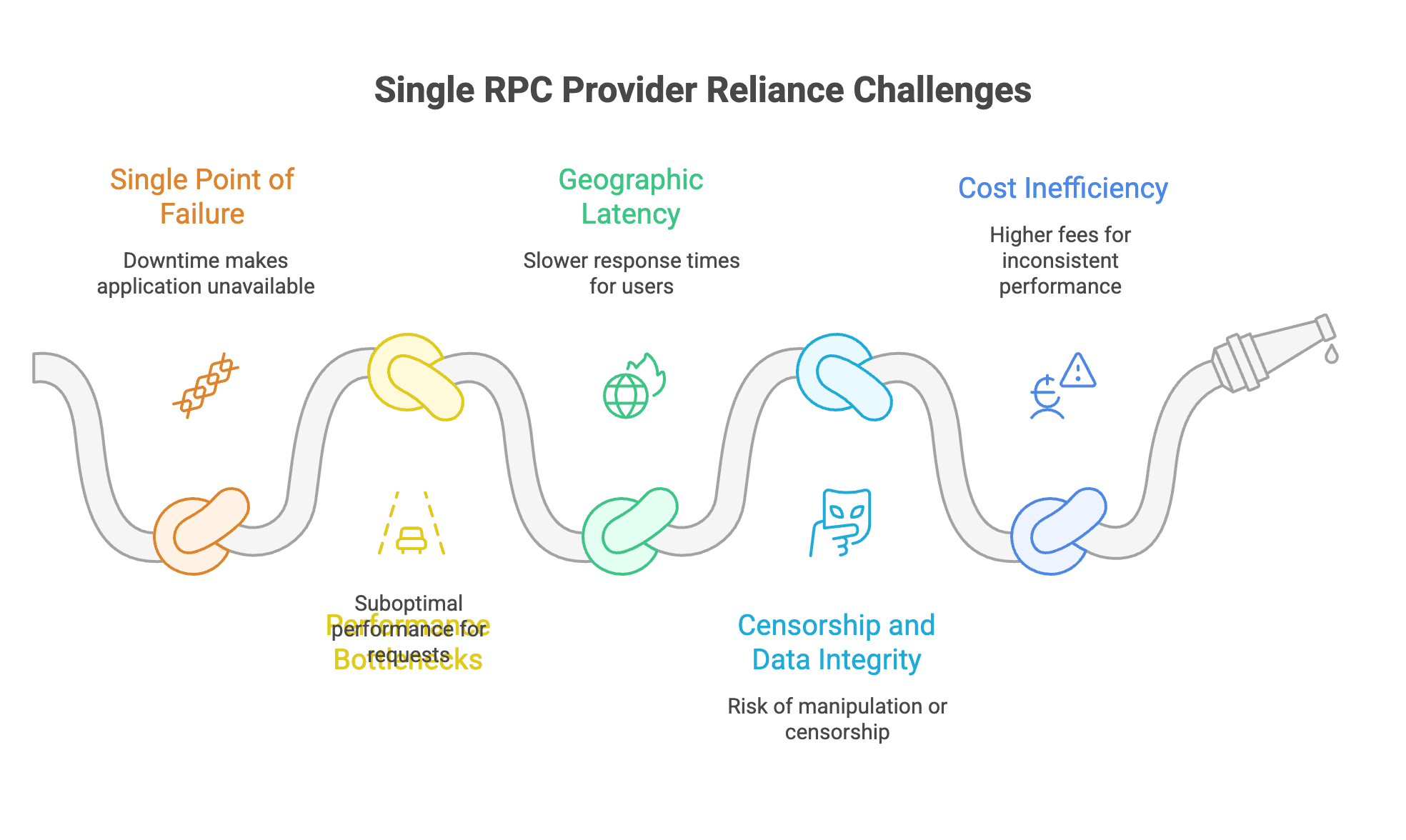
Single Point of Failure: If the chosen provider experiences downtime, network congestion, or other issues, the application becomes unavailable or experiences degraded performance.
Performance Bottlenecks: Different RPC providers may have varying levels of performance depending on their infrastructure, geographic location, and network conditions. A single provider might not always offer the optimal performance for all requests.
Geographic Latency: Users located far from the RPC provider's servers may experience higher latency, leading to slower application response times.
Censorship and Data Integrity: While less common, there's a risk of censorship or data manipulation if the RPC provider is compromised or subject to external pressures.
Cost Inefficiency: Some RPC providers may charge higher fees for their services, even if their performance isn't consistently superior.
The Solution: Live Smart Routing
Live smart routing addresses these challenges by dynamically selecting the best RPC provider for each request based on real-time performance metrics. This approach offers several advantages:
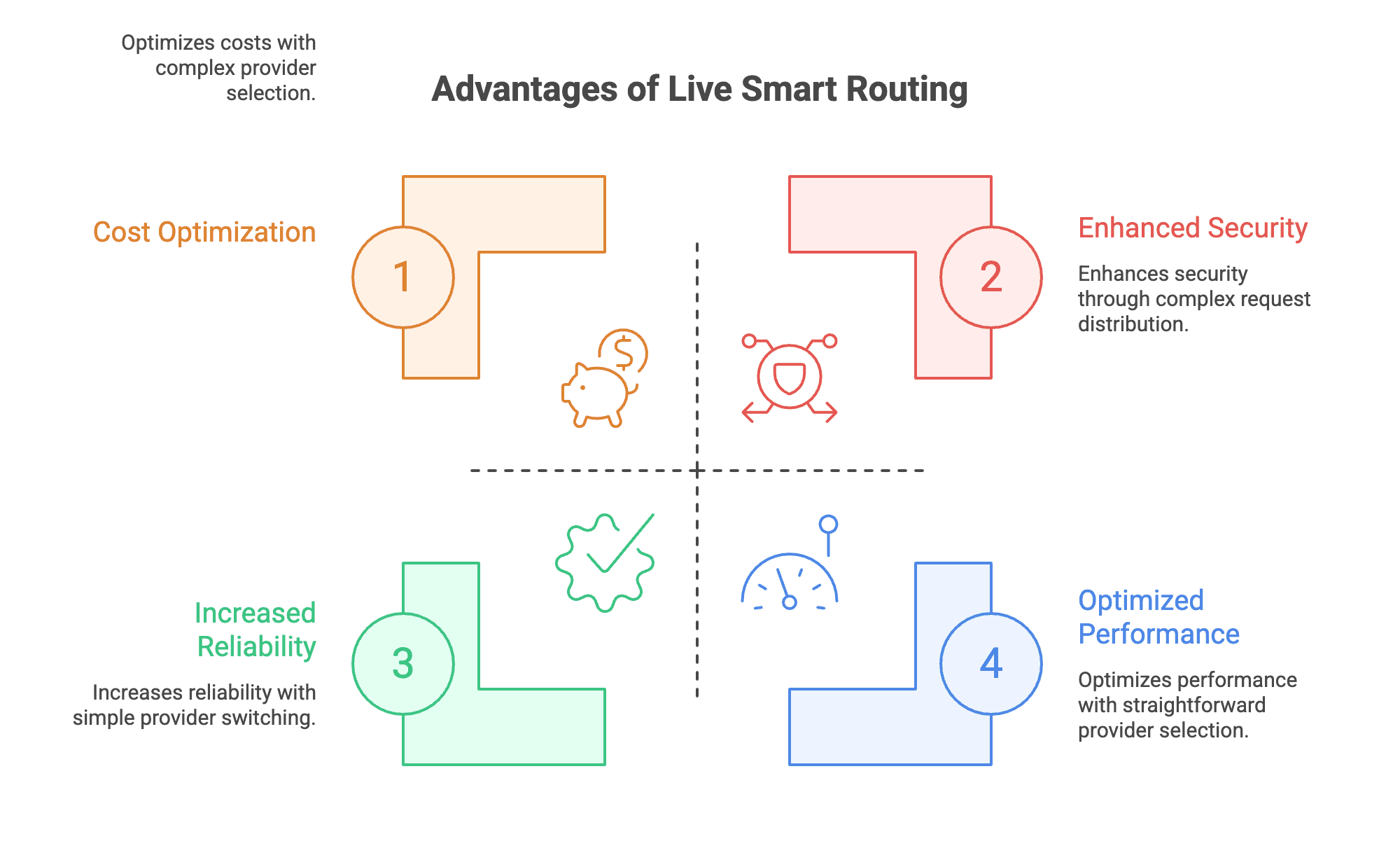
Increased Reliability: By automatically switching to a healthy provider in case of downtime or performance degradation, smart routing ensures high availability and resilience.
Optimized Performance: Smart routing selects the provider with the lowest latency, highest throughput, and most reliable connection for each request, resulting in faster application response times and a better user experience.
Reduced Latency: By considering the user's geographic location and the provider's server locations, smart routing minimizes latency and improves performance for users worldwide.
Enhanced Security: By distributing requests across multiple providers, smart routing reduces the risk of censorship and data manipulation.
Cost Optimization: Smart routing can intelligently route requests to the most cost-effective provider based on current pricing and performance, minimizing overall expenses.
How Live Smart Routing Works
Live smart routing involves several key components and processes:
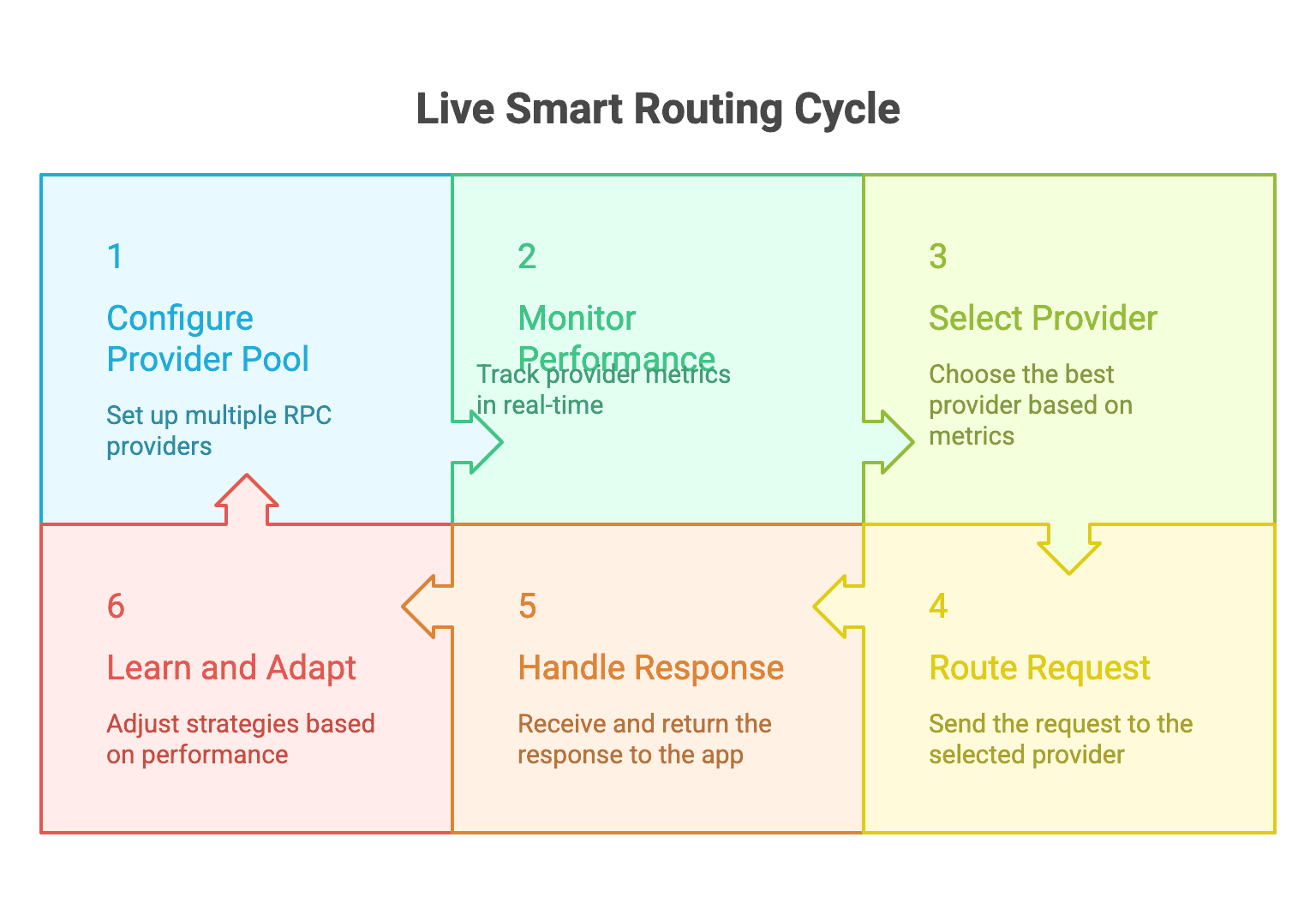
Provider Pool: A pool of multiple RPC providers is configured, each offering access to the same blockchain network.
Real-time Monitoring: The smart routing system continuously monitors the performance of each provider in the pool. This monitoring includes metrics such as:
Latency: The time it takes for a request to be processed and a response to be received.
Success Rate: The percentage of requests that are successfully processed without errors.
Throughput: The number of requests that can be processed per unit of time.
Availability: The percentage of time that the provider is online and accessible.
Error Rates: The frequency of different types of errors encountered.
Dynamic Provider Selection: Based on the real-time performance metrics, the smart routing system dynamically selects the best provider for each request. This selection process typically involves:
Weighting: Assigning weights to each provider based on their performance metrics. Providers with lower latency, higher success rates, and higher throughput receive higher weights.
Load Balancing: Distributing requests across multiple providers to prevent any single provider from being overloaded.
Failover: Automatically switching to a backup provider if the primary provider becomes unavailable or experiences performance degradation.
Geographic Routing: Routing requests to providers with servers located closer to the user's geographic location.
Request Routing: The smart routing system intercepts requests from the Web3 application and routes them to the selected provider.
Response Handling: The smart routing system receives the response from the provider and returns it to the application.
Learning and Adaptation: The smart routing system continuously learns from its past performance and adapts its routing strategies to optimize performance over time. This may involve adjusting the weights assigned to different providers, modifying the load balancing algorithm, or refining the failover mechanism.
Key Considerations for Implementing Live Smart Routing
Implementing live smart routing requires careful consideration of several factors:
Provider Selection: Choosing a diverse set of RPC providers with different infrastructure, geographic locations, and pricing models is crucial.
Monitoring Infrastructure: Implementing a robust monitoring infrastructure that can accurately track the performance of each provider in real-time is essential.
Routing Algorithm: Selecting an appropriate routing algorithm that balances performance, reliability, and cost is critical.
Configuration and Management: Providing a user-friendly interface for configuring and managing the smart routing system is important.
Security: Ensuring the security of the smart routing system and protecting it from attacks is paramount.
Cost Analysis: Evaluating the cost-effectiveness of smart routing compared to relying on a single provider is necessary.
Benefits of Live Smart Routing
The benefits of live smart routing extend beyond just performance and reliability. They include:
Improved User Experience: Faster response times and reduced latency lead to a smoother and more responsive user experience.
Increased Application Adoption: A better user experience can drive increased adoption of Web3 applications.
Reduced Operational Costs: Optimized resource utilization and reduced downtime can lower operational costs.
Enhanced Scalability: Smart routing enables applications to scale more easily by distributing load across multiple providers.
Greater Flexibility: Smart routing provides greater flexibility in choosing and managing RPC providers.
Future-Proofing: Smart routing helps future-proof applications by making them more resilient to changes in the Web3 ecosystem.
Conclusion
Live smart routing is a powerful technique for optimizing the performance, reliability, and cost-effectiveness of Web3 applications. By dynamically selecting the best RPC provider for each request based on real-time performance metrics, smart routing ensures high availability, low latency, and optimal resource utilization. As the Web3 ecosystem continues to evolve, live smart routing will become an increasingly important tool for building robust and scalable decentralized applications.